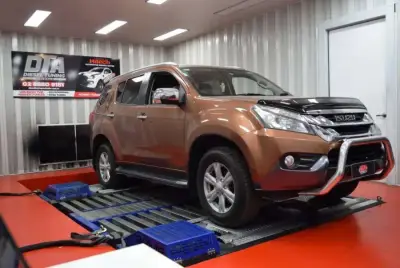
The D-Max has earned a reputation for reliability that few utes can match, and Isuzu owners tend to keep their vehicles for very high mileage. A custom remap is typically done at 100,000–150,000 km when owners want to recover performance lost to EGR carbon, or when the vehicle is being set up for serious towing work. Our maps for the 4JJ1, 4JJ3 and RZ4E are developed with long-term durability as the priority — we want this engine at 500,000 km.
The 3 L 4-cylinder in the Isuzu D-Max is a solid, mid-range diesel — enough torque to be genuinely useful, calibrated cautiously enough to survive every market where the manufacturer sells it. The result is a factory map that's deliberately muted. Most of the real-world gain we make on a remap comes from recovering that headroom safely.
Our dyno-developed map for the Isuzu D-Max adds an average of 20 kW (23%) at the wheels and 86 Nm (19%) of engine torque. At this level the car genuinely changes character — overtaking on single-lane highways stops being a commitment, and the mid-range pull from around 1,500 to 3,000 rpm is transformed. You notice it most on the highway on-ramp and in the first third of an overtake.
In practical terms, that works out to around 9 fewer tanks of diesel over 40,000 km. At a typical 15,000 km annual mileage, most Isuzu D-Max owners save roughly 249 L and $299 per year at the pump — purely from improved combustion efficiency at part-throttle, where diesels spend most of their time.
This Isuzu D-Max variant ran from 2021–2025 — long enough that the factory calibration was revised more than once during that run. Before we flash anything, we identify the exact year and ECU revision, read and back up the original file, and then apply the map built for that specific version.
Isuzu 4JJ1
The 3.0 L 4JJ1 in older D-Max and MU-X is a reputation-makingly durable common-rail diesel. The factory tune is deliberately mild for global emissions — a custom map brings the engine to where it should have been from the showroom.