The 2 L engine in the Mercedes-Benz E Class is at the top end of what this displacement produces — serious injection pressure, sophisticated turbocharger management, and a factory calibration that leaves room on the table by design. These engines are well-engineered enough that a careful, dyno-developed map extracts meaningful gains without asking anything the hardware isn't already built to handle.
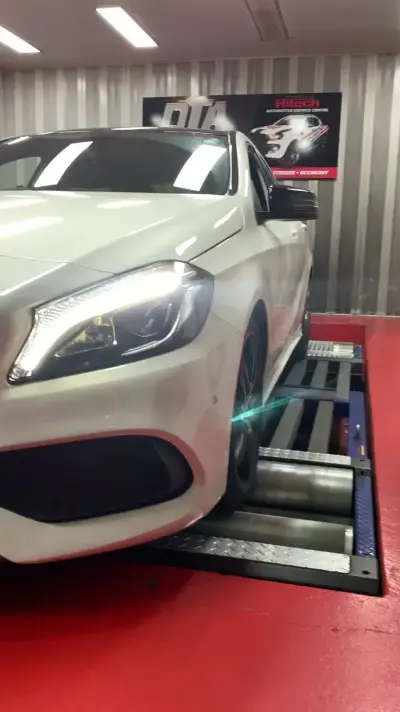
Our dyno-developed map for the Mercedes-Benz E Class adds an average of 28 kW (25%) at the wheels and 100 Nm (25%) of engine torque. At this level the car genuinely changes character — overtaking on single-lane highways stops being a commitment, and the mid-range pull from around 1,500 to 3,000 rpm is transformed. You notice it most on the highway on-ramp and in the first third of an overtake.
In practical terms, that works out to around 5 fewer tanks of diesel over 40,000 km. At a typical 15,000 km annual mileage, most Mercedes-Benz E Class owners save roughly 123 L and $148 per year at the pump — purely from improved combustion efficiency at part-throttle, where diesels spend most of their time.
This Mercedes-Benz E Class variant ran from 2016–2020 — long enough that the factory calibration was revised more than once during that run. Before we flash anything, we identify the exact year and ECU revision, read and back up the original file, and then apply the map built for that specific version.
Mercedes-Benz OM654
The OM654 (post-2016, 2.0 inline-four) is one of the cleanest, smoothest diesels on sale. We hold our tunes conservatively here — there is calibration headroom, but the factory map is already very close to the engine's sweet spot.