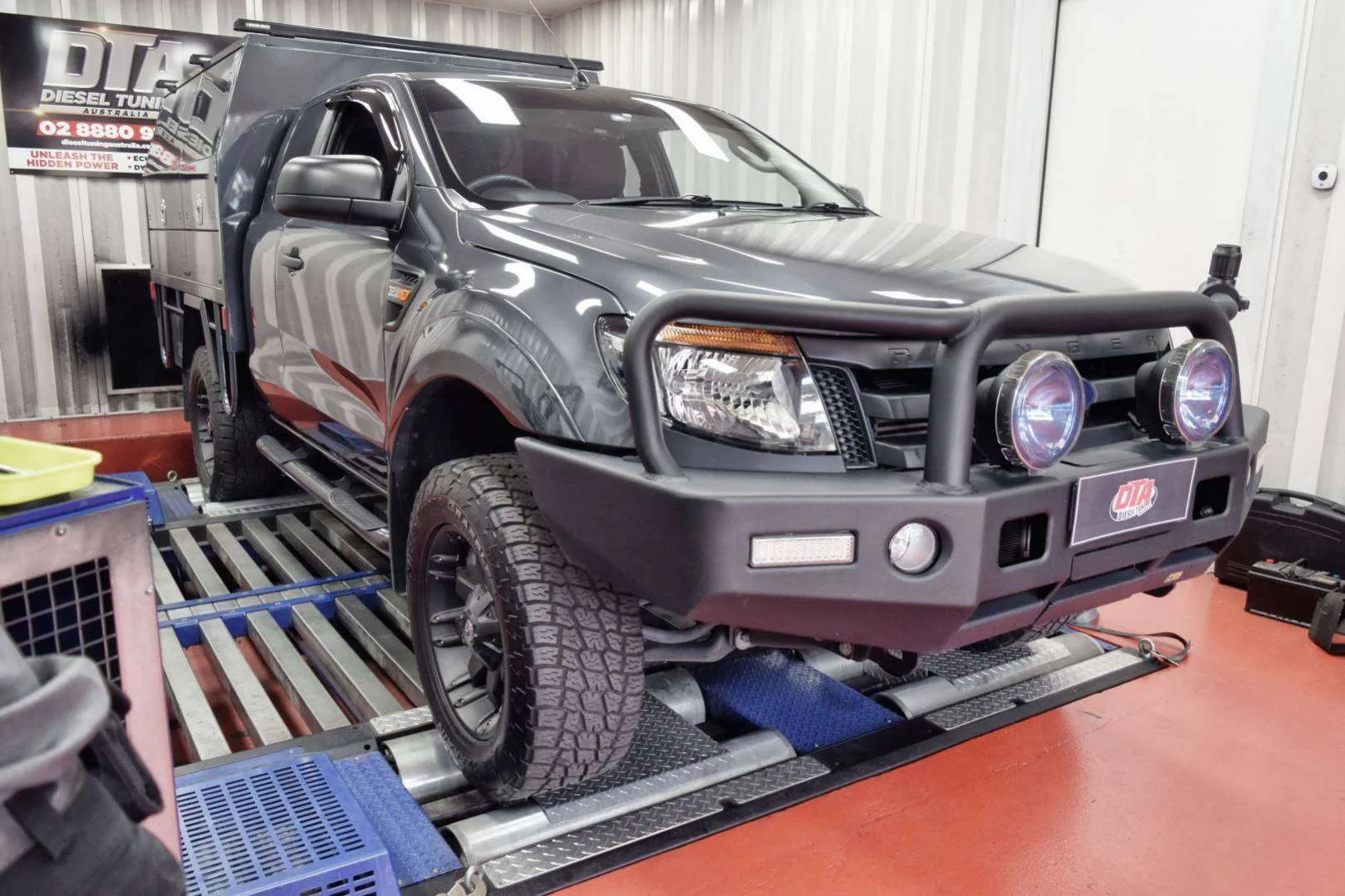
The HiAce is a commercial workhorse — tradies, fleet operators, school runs, camper conversions. The 2.8 L 1GD-FTV in the H300 is the same engine family as the Hilux and Prado, with the same conservative factory tune. Most HiAce owners remap for one of two reasons: better pull when the van is loaded to GVM, or better fuel economy on high-kilometre daily runs. Both are achievable on the dyno without touching the hardware.
The 2.8 L 4-cylinder in the Toyota HiAce is a solid, mid-range diesel — enough torque to be genuinely useful, calibrated cautiously enough to survive every market where the manufacturer sells it. The result is a factory map that's deliberately muted. Most of the real-world gain we make on a remap comes from recovering that headroom safely.
Our dyno-developed map for the Toyota HiAce adds an average of 25 kW (24%) at the wheels and 112 Nm (25%) of engine torque. At this level the car genuinely changes character — overtaking on single-lane highways stops being a commitment, and the mid-range pull from around 1,500 to 3,000 rpm is transformed. You notice it most on the highway on-ramp and in the first third of an overtake.
In practical terms, that works out to around 9 fewer tanks of diesel over 40,000 km. At a typical 15,000 km annual mileage, most Toyota HiAce owners save roughly 225 L and $405 per year at the pump — purely from improved combustion efficiency at part-throttle, where diesels spend most of their time.
This Toyota HiAce variant ran from 2019–2025 — long enough that the factory calibration was revised more than once during that run. Before we flash anything, we identify the exact year and ECU revision, read and back up the original file, and then apply the map built for that specific version.
Toyota 1GD-FTV
The 2.8 L 1GD-FTV replaced the 1KD on the Hilux, Prado and Fortuner. It came with a tighter factory map for emissions compliance, which leaves real headroom for a careful remap — most owners feel the difference immediately on the throttle.